
Company Biography
Click on the 'Resources' tab to download the ePoster.
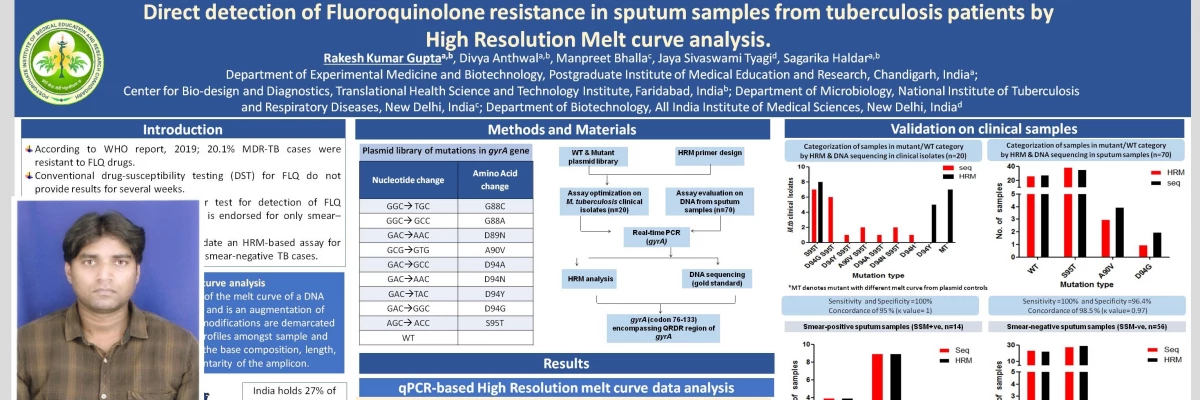
Direct detection of Fluoroquinolones resistance in sputum samples from tuberculosis patients by High Resolution Melt curve analysis
Rakesh Kumar Guptaa, Divya Anthwala, Manpreet Bhallab, Jaya Sivaswami Tyagic, Sagarika Haldara,d
Department of Experimental Medicine and Biotechnology, Postgraduate Institute of Medical Education and Research, Sector 12, Chandigarha; Department of Microbiology, National Institute of Tuberculosis and Respiratory Diseases, Mehrauli, New Delhib; Department of Biotechnology, All India Institute of Medical Sciences, Ansari Nagar, New Delhic; Center for Bio-design and Diagnostics, Translational Health Science and Technology Institute, NCR Biotech Science Cluster, 3rd Milestone, Faridabad – Gurgaon Expressway, PO box #04, Faridabadd
Abstract: Tuberculosis (TB) remains one of the most serious infectious diseases worldwide causing 1.3 million deaths in 2017. TB treatment due to multidrug-resistant TB (MDR-TB) requires the use of fluoroquinolones (FLQ) and excessive use of FLQ has led to the rise of extensively drug-resistant TB (XDR-TB). In 2017, 22% MDR-TB cases were resistant to FLQ drugs. This study was carried out to evaluate the utility of high-resolution melt curve analysis (HRM) for the rapid and direct detection of FLQ resistance in M. tuberculosis in sputum samples. A reference plasmid library was generated for most frequently observed mutations of gyrA gene and used as the positive-controls in HRM, then evaluated in 20 MDR-M. tuberculosis clinical isolates. The assay was validated on DNA isolated from 70 M. tuberculosis culture-positive sputum samples (including 56 smear-negative samples) using DNA sequencing as gold standard. Mutants were discriminated from wild-type by comparing melting-curve patterns with those of control plasmids. The FLQ-HRM assay had a sensitivity and specificity of 100% and 96.4%, respectively and also detected the natural polymorphism (S95T mutation) in 39/70 samples. HRM is a rapid, cost-effective (INR 180/USD2.8) and closed-tube method for direct detection of FLQ resistance in sputum samples especially for smear-negative sputum samples.